Famous Firearms Used in Historic Battles
The course of history has often been shaped by the weapons wielded on the battlefield. Firearms, in particular, revolutionized warfare from the late medieval period onward, influencing tactics, outcomes, and even geopolitical landscapes. This article explores some of the most famous firearms used in historic battles, shedding light on their technological advancements, battlefield impact, and enduring legacies.
The Matchlock Musket: The Dawn of Firearm Warfare
Before the widespread adoption of modern firearms, the matchlock musket was a groundbreaking weapon that changed how armies fought. Emerging in Europe during the 15th century, the matchlock musket was among the first firearms to incorporate a mechanical firing mechanism, making it more reliable than earlier hand cannons and arquebuses.
One of the most notable uses of matchlock muskets was during the Battle of Pavia (1525), where Spanish forces decisively defeated the French army. The Spanish infantry’s superior use of muskets combined with pikemen formations demonstrated early combined arms tactics that would dominate European battlefields for centuries.
- Design Features: The matchlock musket used a slow-burning match cord to ignite gunpowder in a pan, firing a lead ball projectile.
- Rate of Fire: Approximately 2-3 rounds per minute due to manual loading and ignition processes.
- Effective Range: Roughly 100-200 meters depending on caliber and powder charge.
This weapon’s impact extended beyond Europe; it also influenced warfare in Asia. For example, Japanese armies adopted matchlock muskets after contact with Portuguese traders in the mid-16th century. The Battle of Nagashino (1575) is particularly famous for Oda Nobunaga’s innovative use of volley fire with matchlock muskets against cavalry charges, marking a turning point in Japanese warfare.
The Flintlock Rifle: Precision and Reliability in Early Modern Warfare
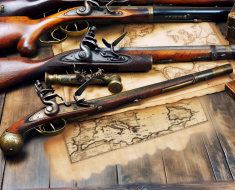
The flintlock mechanism replaced the less reliable matchlock in the 17th century. This advancement allowed for faster ignition and greater durability under various weather conditions. The flintlock rifle became an essential weapon for infantry across Europe and America during this period.
A key example is its role during the American Revolutionary War (1775–1783). American colonial militias and Continental Army troops utilized flintlock muskets and rifles to great effect against British forces. Notably, riflemen equipped with Pennsylvania or Kentucky rifles—early versions of flintlock rifles—used their superior accuracy to harass enemy lines from longer distances than traditional muskets allowed.
- Technological Advantages: Flint striking steel produced sparks to ignite powder more reliably than matches.
- Tactical Use: Enabled skirmishers and sharpshooters to engage targets at ranges up to 300 meters.
- Cultural Impact: The Kentucky rifle became an iconic symbol of American frontier spirit and marksmanship.
The flintlock also played a critical role during the Napoleonic Wars (1803–1815), where line infantry armed with flintlock muskets engaged in massive set-piece battles like Austerlitz (1805) and Waterloo (1815). These weapons defined an era where discipline and volley fire dominated battlefields before rapid-fire technologies emerged.
The Gatling Gun: Birth of Rapid-Fire Weaponry
The invention of rapid-fire weapons marked another leap forward in firearm technology. One such revolutionary firearm was the Gatling gun, patented by Richard Jordan Gatling in 1862. As one of the first successful machine guns, it dramatically increased firepower available to armies during the latter half of the 19th century.
The Gatling gun saw action during several historic conflicts, most notably during the American Civil War (1861–1865) and later colonial campaigns such as British actions in Africa. Although it did not see widespread use during the Civil War due to logistical constraints, its potential was evident as it could fire up to 600 rounds per minute using multiple rotating barrels powered by a hand crank.
- Design Highlights: Multiple barrels rotating around a central axis reduced overheating problems common with single-barrel weapons.
- Tactical Impact: Ideal for defensive positions against massed infantry attacks or cavalry charges.
- Limitations: Heavy weight and reliance on manual cranking limited mobility compared to later automatic weapons.
The Gatling gun’s legacy paved the way for modern automatic machine guns like Hiram Maxim’s design that would dominate World War I battlefields just decades later. Its psychological effect on enemy troops also changed how infantry assaults were conducted in an era transitioning toward mechanized warfare.
The Lee-Enfield Rifle: The Backbone of British Infantry
Among bolt-action rifles developed at the turn of the 20th century, the Lee-Enfield stands out as one of history’s most renowned military firearms. Introduced by Britain in 1895, it served as the standard-issue rifle through both World Wars and beyond due to its reliability, accuracy, and high rate of fire for a bolt-action rifle.
The Lee-Enfield was famously used during battles such as the Somme (1916) and El Alamein (1942).
Its smooth bolt operation allowed trained soldiers to fire up to 20 rounds per minute, making it a formidable weapon in the hands of skilled marksmen. The Lee-Enfield’s combination of firepower and reliability solidified its place in military history.
These iconic firearms not only shaped the tactics of their time but also left a lasting impact on modern weaponry and military strategy.