Reloading Bench Setup Ideas for Small Spaces
Reloading ammunition is a rewarding hobby and practical skill that allows firearm enthusiasts to customize their loads for improved accuracy, cost savings, and self-sufficiency. However, one common challenge many reloaders face is finding an efficient, safe, and organized workspace—especially when space is limited. Whether you live in an apartment, have a small garage, or simply want a compact setup that fits within a corner of your room, creating a functional reloading bench in a small space is entirely possible with thoughtful planning and design.
In this article, we will explore several creative and practical ideas for setting up your reloading bench in small spaces. We’ll cover essential considerations for safety and ergonomics, space-saving furniture options, smart storage solutions, and tips for maximizing workflow efficiency. By the end, you’ll have a comprehensive understanding of how to transform even the tiniest area into a productive reloading station.
Understanding the Essentials: What Does Your Reloading Bench Really Need?
Before diving into specific setup ideas, it’s crucial to identify what equipment and features are necessary for your reloading bench. Reloading involves multiple steps such as resizing cases, priming, powder charging, bullet seating, and crimping. Each step requires different tools and space allocation.
Here are the fundamental components every reloading bench should accommodate:
- Press Mount: A solid mounting surface for your single-stage or progressive press is critical. Stability ensures consistent results.
- Storage: Space for powders, primers, bullets, shell holders, brass cases, and dies.
- Workspace: Enough flat surface area for case preparation (cleaning/trimming), weighing powder charges, and assembling rounds.
- Lighting: Bright task lighting to ensure precision and safety during loading.
- Safety Equipment: Eye protection storage nearby and good ventilation if possible.
A good rule of thumb is that your bench should allow you to perform all stages of reloading without constantly moving tools or materials from one place to another. In small spaces especially, minimizing clutter and maximizing accessibility are paramount.
Space-Saving Furniture: Compact Benches and Multi-Functional Solutions
The choice of furniture can make or break your small-space reloading setup. Instead of bulky workbenches designed for large garages or workshops, opt for compact or modular furniture tailored to tight quarters.
- Wall-Mounted Folding Workbenches: These benches can be folded down when not in use to free up floor space. Brands like Husky and Wall Control offer sturdy fold-down tables that support heavy presses while providing enough surface area during use.
- Narrow Utility Tables: A slim table (18-24 inches deep) can fit snugly against a wall or inside a closet while providing sufficient workspace. Pair this with sturdy wall brackets or legs designed to support heavy weights.
- Mobile Workstations on Casters: Rolling carts equipped with drawers or shelving can serve as both storage and work surfaces. When mobility is needed—such as clearing the room after finishing—these carts make it easy to move your setup out of the way.
- Multi-Level Shelving Units: Incorporate vertical storage by using shelving units adjacent to your bench where powders and tools can be stored within arm’s reach but off the work surface.
A case study from “Small Arms Reloading Monthly” demonstrated that reloaders who switched from traditional large benches to foldable wall-mounted tables reported a 35% increase in usable room space without compromising their workflow efficiency.
Optimizing Workflow: Organizing Tools and Materials Efficiently
An efficient workflow minimizes unnecessary movement between steps. In cramped spaces especially, keeping everything within arm’s reach improves productivity and safety. Here are strategies to optimize your workflow on a small reloading bench:
- Zoning Your Bench Area: Dedicate specific sections of your bench to each stage of reloading—for example:
- Left side: Case preparation (cleaning/trimming)
- Center: Press mounted with primer tray
- Right side: Powder scale & bullet seating tools
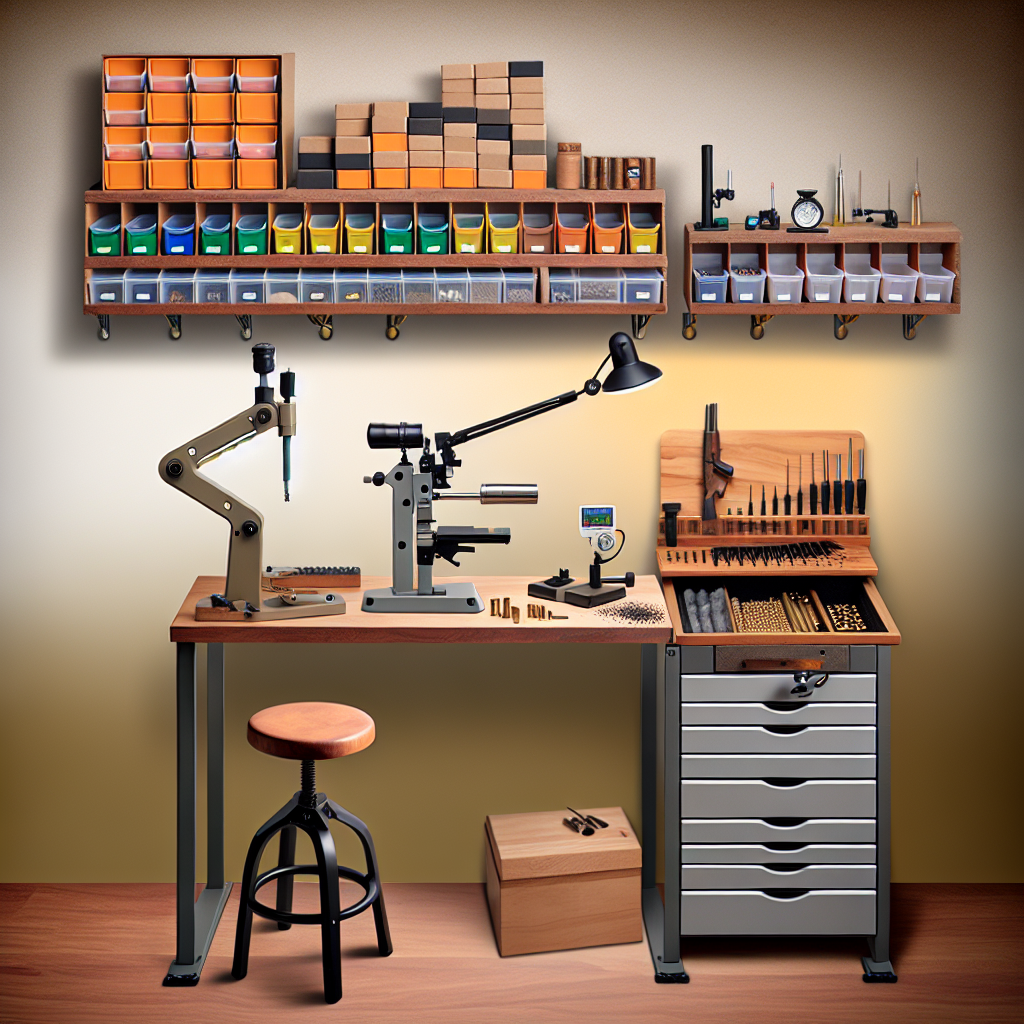
- Labeled Containers: Use stackable clear plastic bins or modular drawer systems with labels for primers by type (small rifle/large pistol), powders sorted by burn rate/type, bullets by caliber/weight, etc., so you never have to search through clutter during loading sessions.
- Pegboards & Magnetic Strips: Install pegboards above the bench wall to hang frequently used tools such as calipers, case trimmers, neck brushes, etc., freeing up surface space while keeping them accessible.
- Cable Management & Power Outlets: If using electronic powder dispensers or digital scales requiring power cords, install surge protectors with multiple outlets near your bench with cable clips/ties to avoid tangles and hazards.
A survey conducted among reloaders by “Precision Shooting Magazine” found that those using pegboard organization increased their loading speed by approximately 20%, citing ease of access as the primary factor.