Top 5 Firearms That Changed History
The evolution of firearms has played a pivotal role in shaping the course of human history. From battlefield dominance to the rise and fall of empires, certain weapons have left an indelible mark not only on warfare but also on society, technology, and geopolitics. This article explores the top five firearms that fundamentally altered historical trajectories, highlighting their design innovations, tactical impacts, and enduring legacies.
1. The Arquebus: Dawn of Gunpowder Warfare
Before the advent of the arquebus in the 15th century, medieval warfare was dominated by swords, bows, and crossbows. The arquebus was one of the earliest shoulder-fired firearms to utilize gunpowder effectively, marking a seismic shift in how battles were fought.
Originating in Europe around the early 1400s, the arquebus featured a matchlock firing mechanism that allowed soldiers to aim and discharge more accurately than previous hand cannons. Though slow to reload and prone to misfires, its psychological impact was profound — the loud noise and penetrating power could break enemy lines previously impervious to ranged attacks.
- Technological innovation: Introduced matchlock firing system enabling more controlled shooting.
- Tactical impact: Enabled infantry to challenge armored knights effectively.
- Historical significance: Played a critical role in battles like the Battle of Cerignola (1503), considered one of the first major victories won through gunpowder weapons.
The widespread adoption of the arquebus led to changes in military formations and tactics. Armored cavalry began to lose their dominance as infantry equipped with arquebuses formed defensive squares and volleys. This transition signaled the gradual decline of medieval knightly warfare and set the stage for modern armies.
2. The AK-47: Symbol of Revolution and Reliability
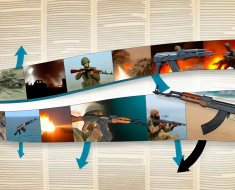
Designed by Mikhail Kalashnikov in 1947, the AK-47 is arguably the most recognizable firearm in history. It revolutionized infantry combat with its unparalleled reliability, simplicity, and ease of manufacture — characteristics that made it a weapon favored by both state armies and insurgent groups worldwide.
The AK-47’s design combined selective fire capabilities (semi-automatic and automatic) with a robust gas-operated mechanism. Its loose tolerances meant it could operate effectively in harsh conditions such as mud, sand, and extreme cold without frequent maintenance.
- Global proliferation: Estimates suggest over 100 million AK-type rifles have been produced worldwide.
- Impact on asymmetric warfare: The AK-47 became synonymous with guerrilla movements during Cold War conflicts across Africa, Asia, and Latin America.
- Cultural iconography: Featured on national flags (e.g., Mozambique) and revolution propaganda materials.
The AK-47’s role extended beyond military applications; it shaped geopolitics by empowering non-state actors against conventional forces. Its influence is evident in conflicts from Vietnam to Afghanistan and even contemporary urban warfare scenarios.
3. The Colt Single Action Army Revolver: The Gun that Tamed the West
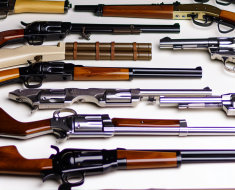
The Colt Single Action Army revolver, introduced in 1873 by Samuel Colt’s company, became an iconic firearm during America’s westward expansion era. Known colloquially as “The Peacemaker,” this revolver symbolized law enforcement authority as well as frontier justice during a turbulent period marked by outlaws, settlers, and Native American conflicts.
The revolver’s design featured a six-shot cylinder with reliable single-action operation — meaning shooters had to manually cock the hammer before each shot but benefited from consistent trigger pulls afterward. Chambered initially for .45 Long Colt rounds, it offered significant stopping power suitable for both self-defense and hunting.
- Cultural impact: Immortalized in Western films shaping American mythology around gunslingers and sheriffs.
- Tactical advantage: Provided quicker firing capability compared to earlier muzzle-loading pistols or rifles.
- Law enforcement use: Adopted by U.S. cavalry units and various police agencies across frontier territories.
This revolver helped establish order during an era where communication delays often meant law enforcement had limited support. Its ruggedness made it practical for unpredictable environments — from dusty trails to saloons — cementing its place as one of history’s most influential handguns.
4. The M16 Rifle: Defining Modern Infantry Combat
The M16 rifle emerged during the Vietnam War as a revolutionary step forward in military small arms technology for U.S. forces. Developed initially by Eugene Stoner in the late 1950s under Armalite’s designations before being adopted by the U.S. military in the early 1960s, it replaced heavier battle rifles like the M14 with a lighter weapon firing smaller caliber rounds at higher velocities.
The M16’s use of intermediate cartridges (.223 Remington/5.56×45mm NATO) allowed soldiers increased ammunition capacity without excessive weight penalty while maintaining effective range capabilities for jungle combat conditions prevalent during Vietnam operations.
- Technical features: Lightweight aluminum alloy construction; selective fire modes including burst fire added later versions;
- Tactical benefits: Enhanced soldier mobility due to reduced weight
and improved accuracy, making it a preferred choice for many infantry units.
Overall, the M16 rifle not only transformed the battlefield dynamics during its time but also set the standard for future military firearms.