The History of the M14 Rifle
The M14 rifle stands as one of the most iconic firearms in American military history. Serving as the standard-issue rifle for the United States armed forces during a critical transitional period, the M14 embodies a blend of innovation, tradition, and tactical evolution. This article delves into the intricate history of the M14 rifle, tracing its development, deployment, impact on warfare, and enduring legacy.
Origins and Development: From M1 Garand to M14
The genesis of the M14 rifle is deeply rooted in the legacy of the M1 Garand, which was the primary service rifle for U.S. forces during World War II and the Korean War. While highly regarded for its reliability and semi-automatic firing capability, by the late 1940s and early 1950s, military strategists recognized that advancements in combat tactics and enemy weaponry necessitated a more versatile firearm.
The post-WWII era saw rapid technological progress in small arms design globally. The Soviet Union’s introduction of the AK-47 assault rifle in 1947 prompted Western militaries to rethink their infantry weapons. The AK-47’s select-fire capability and intermediate cartridge gave it distinct advantages in close to mid-range combat situations.
In response to this evolving landscape, U.S. military officials sought a new rifle that would combine accuracy, firepower, and versatility. The goal was to develop a weapon capable of both semi-automatic precision fire at longer ranges and fully automatic suppressive fire when necessary.
- Key Requirements: Improved range over intermediate cartridges; select-fire capability; lighter weight compared to earlier rifles.
- Design Goals: Chambered for 7.62x51mm NATO round; compatibility with NATO standards; ruggedness suitable for various environments.
The result was an evolutionary design process culminating in the creation of the T44 prototype rifle by Springfield Armory engineers. After rigorous testing and competition against other designs (notably from FN Herstal), this prototype was adopted as the M14 rifle in 1957.
Technical Specifications and Innovations
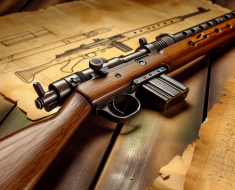
The M14 rifle incorporated several notable features that distinguished it from its predecessors:
- Caliber: Chambered for the powerful 7.62x51mm NATO cartridge, offering superior range and stopping power compared to intermediate rounds like the .30 Carbine or .223 Remington.
- Operating Mechanism: Gas-operated, rotating bolt system inherited from the Garand but modified for select-fire capability.
- Fire Modes: Capable of semi-automatic fire for accuracy and full automatic fire for suppressive purposes.
- Magazine Capacity: Detachable box magazine holding 20 rounds (an improvement over Garand’s fixed eight-round en bloc clip).
- Sights: Adjustable iron sights with provision for optical scopes on sniper variants.
The incorporation of a detachable magazine was particularly significant as it allowed faster reloads in combat situations. Additionally, despite its heavier weight (approximately 9.2 lbs loaded), soldiers appreciated its ruggedness and long-range effectiveness.
M14 in Service: Deployment and Combat Use
The M14 officially entered service in 1959, replacing both the M1 Garand and several submachine guns within U.S. forces. Its initial deployment coincided with rising Cold War tensions and eventually saw extensive use during early stages of the Vietnam War.
Vietnam War Experience:
The Vietnam conflict presented unique challenges that tested the capabilities of all infantry weapons used by American troops. Dense jungles, guerrilla tactics employed by Viet Cong fighters, and close-quarters engagements demanded adaptability from soldiers’ rifles.
- Semi-Automatic Precision: The M14 excelled at longer-range engagements due to its powerful cartridge but was less suited to rapid-fire close combat scenarios compared to smaller-caliber assault rifles.
- Full-Auto Challenges: The full-auto mode proved difficult to control because of significant recoil generated by the powerful round, often resulting in decreased accuracy during automatic bursts.
The limitations exposed during Vietnam led to growing interest within military circles for a lighter rifle chambered in an intermediate cartridge better suited for jungle warfare conditions—ultimately catalyzing development of what would become the M16 rifle chambered in .223 Remington/5.56x45mm NATO.
M14’s Transition and Continued Relevance
By 1964, after only a few years as standard issue, the M14 began being phased out from frontline infantry units in favor of the newer M16 rifle due to several factors including weight considerations, controllability during automatic fire, and ease of manufacture at scale.
- M16 Advantages: Lighter weight (~6.5 lbs loaded), smaller caliber allowing soldiers to carry more ammunition, better controllability during full-auto bursts.
However, despite being supplanted as a primary infantry weapon, the M14 did not disappear from U.S. military service altogether.
Designated Marksman Rifle (DMR): With modifications such as improved optics and accuracy enhancements, certain variants like the M14 became valuable assets for designated marksmen in various conflicts.
Today, the M14 continues to serve in specialized roles, showcasing its enduring legacy in military history.