Essential Skills for Defensive Pistol Shooting
Defensive pistol shooting is a critical skill set for individuals who want to protect themselves, their families, and their communities in high-stress situations. Unlike competitive shooting or recreational target practice, defensive shooting demands precision, speed, and situational awareness under pressure. Mastery of this skill can mean the difference between life and death.
This article explores the essential skills every defensive pistol shooter must develop. Drawing on expert opinions, case studies, and real-world statistics, we will provide a comprehensive guide to help you build competence and confidence with your defensive firearm.
Understanding Defensive Pistol Shooting: More Than Just Accuracy
Many beginners assume that being an accurate shot is the single most important aspect of defensive pistol shooting. While accuracy is crucial, it’s only one piece of the puzzle. Defensive shooting requires a combination of skills that work harmoniously in dynamic and often unpredictable scenarios.
According to a 2018 study by the FBI examining officer-involved shootings, nearly 80% of encounters occur at distances under 7 yards (21 feet), emphasizing the need for rapid target acquisition and close-quarters proficiency. Therefore, shooters must focus on:
- Speed: The ability to draw and fire quickly can neutralize threats before they escalate.
- Situational Awareness: Recognizing threats and understanding your environment reduces risks.
- Control Under Stress: Managing adrenaline and maintaining composure ensures effective decision-making.
In essence, defensive pistol shooting is about survival—combining mental preparedness with physical skill.
Fundamental Skills: Grip, Stance, and Sight Alignment
The foundation of every successful shot starts with proper fundamentals. These basics influence recoil management, shot placement, and follow-up speed.
Grip
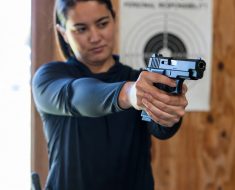
A strong, consistent grip controls muzzle rise and enhances accuracy. The recommended two-handed grip involves wrapping your dominant hand firmly around the pistol grip while your support hand covers as much of the exposed frame as possible. This method improves recoil control significantly compared to a one-handed grip.
Case Study: In a training program conducted by the US Marine Corps Marksmanship Unit (USMC MU), shooters who adopted the two-handed grip demonstrated a 40% faster follow-up shot time during simulated engagements compared to those using a single-handed hold.
Stance
The stance provides balance and stability during shooting. The most commonly taught stance for defensive use is the Isosceles stance:
- Shooter faces the target squarely with feet shoulder-width apart
- Knees slightly bent for shock absorption
- Arms extended fully forward forming an isosceles triangle with shoulders
This stance allows for better recoil control and mobility if movement is necessary during an encounter.
Sight Alignment and Picture
Sight alignment means lining up your front sight within the rear sight notch evenly. Sight picture involves placing this aligned sight on your intended target area—usually center mass for defensive scenarios. Prioritizing front sight focus over the target or rear sights improves shot precision dramatically.
- Studies show shooters who focus on front sight achieve accuracy rates above 85% at typical defensive distances (3-7 yards).
- Poor sight focus contributes to missed shots that can have serious consequences in real-life situations.
Drawing from Concealment: Speed Meets Safety
A concealed carry permit does not guarantee safety; how quickly and safely you can draw your weapon from concealment is vital in a life-threatening situation. This skill requires repetition under realistic conditions to build muscle memory without compromising safety protocols.
- Smooth Draw Stroke: Avoid jerky movements that might snag clothing or alert an attacker prematurely.
- Muzzle Discipline: Always keep your firearm pointed in a safe direction during your draw sequence until you identify a clear threat.
- Trigger Finger Control: Keep your finger indexed outside the trigger guard until ready to shoot to prevent negligent discharges.
A report published by the National Tactical Officers Association (NTOA) highlighted that officers who trained regularly on their draw from concealment improved their average draw time by nearly 30%, while also reducing accidental discharges by over 50% due to better trigger discipline practices.
Shooting Under Stress: Managing Adrenaline and Decision-Making
The human body’s natural response to danger triggers adrenaline surges that can impair fine motor skills such as trigger control or sight alignment. Developing resilience against these effects is essential for effective defensive shooting.
Mental Conditioning Techniques
- Tactical Breathing: Controlled breathing reduces heart rate and improves focus during high-stress moments.
- Mental Rehearsal: Visualizing threat encounters helps prepare your mind for real events by establishing neural pathways for calm reactions.
- Stress Inoculation Training (SIT): Simulated stress drills replicate physiological responses allowing shooters to practice skills under pressure safely.
A study conducted at Texas A&M University found that participants undergoing SIT showed a marked improvement in their ability to maintain accuracy under stress compared to those trained only under
traditional methods.
Incorporating these techniques into your training regimen can significantly enhance your defensive shooting skills and overall preparedness.